History and Developments
History
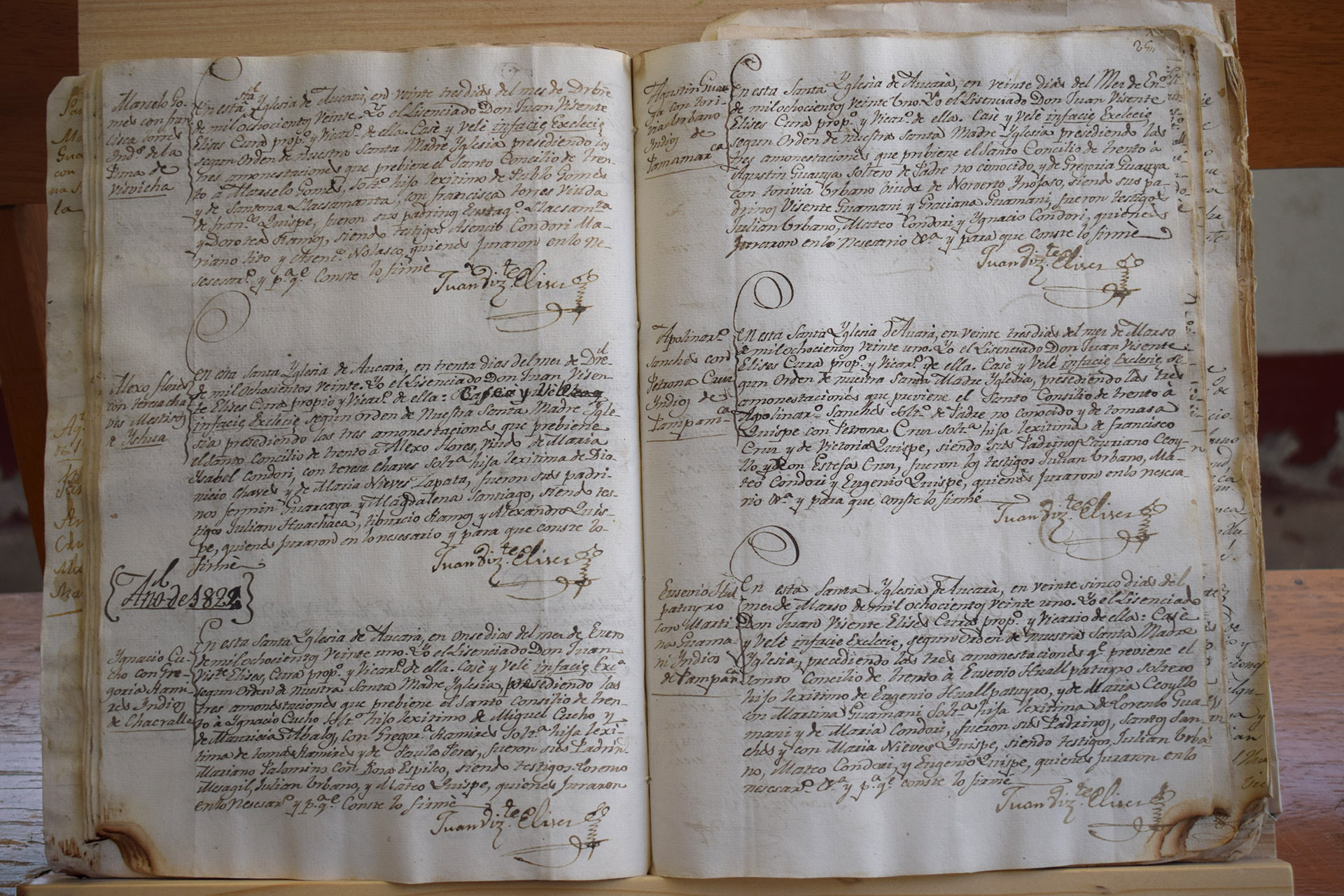
The sources we studied were compiled by the team at the French Institute of Andean Studies as part of the cultural heritage preservation and appreciation project, Patrimonio del valle del Sondondo, launched in 2019.
In addition to the restoration of the churches and the recognition of the artistic heritage of the Sondondo, work was carried out to search for, compile, and digitize historical documentation. This initiative led to the creation of a virtual archive of hundreds of documents and thousands of pages currently hosted on Humanum, the website of the Centre National de la Recherche Scientifique (CNRS) in France.
In 2022, Gabriela Ramos secured financial support from the global-scale project Imagining Futures (IF), led by Elena Isayev, a historian at the University of Exeter. In line with IF’s mission, our work sought not only to rescue vulnerable archives but also to begin processing and studying the documents to reconstruct the history of communities whose past has remained silenced. In the case of Sondondo, conditions such as the still scarce research on rural Andean areas, the still limited understanding of the region, and the marginalization to which it has been subjected by the state are compounded by the political violence that ravaged significant sectors of rural populations between the late twentieth and early twenty-first centuries.
The support we received from the IF project, Producing a manageable historical archive for Andean communities, has served, first, to make this digital archive accessible to its original owners and, second, to develop a series of tools to support the historical analysis of its population between the 17th and 20th centuries.
During the first phase of work, carried out between 2023 and 2024, we chose to study the parish records of the town of Aucará. The documentation in this parish archive begins in the late 17th century. Although there are some chronological gaps, the documents contain important—and even unique—information about the valley’s population. To protect the privacy of individuals and families, we set the second decade of the 20th century as the cutoff point for the study of these records.
Three history and archaeology students participated in this phase: James Quilca Chuco, Grecia Roque Ortega, and Edwin Gonzales Rojas. The French Institute of Andean Studies provided one of its rooms for them to carry out their work. The team entered the information from the documents (records of baptisms, marriages, and burials) into digital templates that capture data on names, places, ethnic characteristics, and tax status, among other variables. While creating the records, various notes on the margins were taken into account that help us understand the circumstances in which people lived and the bonds they formed or maintained with one another.
In collaboration with the Fundación Neogranadina, which has extensive and pioneering experience in Digital Humanities projects in Latin America, the team catalogued more than 10,000 records contained in parish registers belonging to Aucará. Following a process of reviewing, organizing, and cleaning this initial database, led by Juan Cobo Betancourt and Jairo Melo Flórez, information on more than 40,000 people was standardized. Cobo Betancourt and Melo Flórez secured financial support to bring in computer science students from California State University, Santa Barbara, who worked on data cleaning and processing throughout 2025. Grecia Roque assisted in verifying the information and prepared a historical geographic index. The dataset, as well as the most significant results from this first phase, are available online.
Developments
With the support of Texas State University, coordinated by José Carlos de la Puente, we began a new phase of work in 2026. Building on the experience gained, a new data collection team is recording and processing information from a second parish, neighboring Aucará. Louie Dean Valencia, professor of history and digital humanities at Texas State University, and historians Carol Jiménez (National University of San Marcos), Camila Núñez (Pontifical Catholic University of Peru), and Liz Marchante (California State University, Santa Barbara) have joined the working group.
The team was responsible for processing the baptismal records of the Santiago de Chipao parish, which included the main church and its two annexes, Mayobamba and Queca, from the 18th century to the early 20th century. So far, the team has recorded nearly 8,000 baptisms and a total of 30,000 individuals, in addition to 70 associated locations. Baptisms celebrated in the annexes of the Cabana and Aucará parishes have also been recorded. Among other insights, these sources reveal kinship and social networks, the social conditions of individuals, and patterns of mobility and migration, both within and outside the valley. They also provide glimpses of daily life and certain work-related activities associated with the church.